By Taylor Thoen Donaldson, RN — Chief Customer Happiness Officer, Joe & Bella
Choosing compression socks sounds simple until you start shopping.
Suddenly you are looking at different pressure levels, confusing size charts, calf measurements, lengths, materials, and use cases. Some pairs are made for everyday comfort, some are made for travel, and others are intended for more specific medical needs. It is easy to end up with socks that are too hard to put on, too tight to wear comfortably, or simply not the right match for what you need.
That is why learning how to choose compression socks matters. The best pair is not just the tightest sock on the shelf. It is the pair that matches your body, your comfort level, and the reason you are wearing them in the first place. Medical and retailer guidance consistently points to the same core factors: choose the right compression level, measure correctly, use the brand’s own sizing chart, and match the sock length to the situation.
This guide breaks the process down step by step so you can choose compression socks with more confidence.
What do compression socks do?

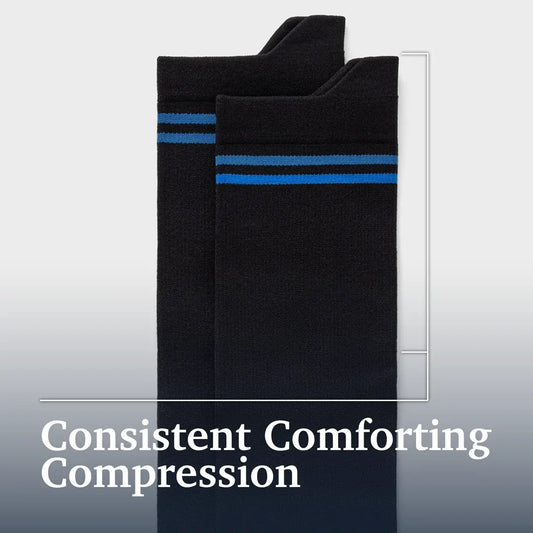
Compression socks apply pressure to the feet and lower legs to help support blood flow. Most are made with graduated compression, which means the pressure is strongest at the ankle and gradually decreases up the leg. That design helps encourage upward blood flow rather than allowing it to pool in the lower legs.
People wear compression socks for a range of reasons, including:
- Swelling in the feet, ankles, or lower legs
- Tired or heavy-feeling legs
- Long periods of sitting
- Standing for long hours
- Travel
- Circulation support
- Clinician-directed use after a procedure or for vein-related issues
The right pair depends on why you need them.
Step 1: Start with why you need compression socks
Before looking at styles, figure out the main reason you want compression socks. This is the first filter.
Ask yourself:
- Are you trying to reduce mild swelling?
- Do your legs feel tired after standing all day?
- Are you shopping for travel?
- Do you want everyday circulation support?
- Did a doctor recommend a specific compression range?
- Are you buying for someone older who needs easier-on socks?
This matters because the best compression socks for a flight are not always the same as the best pair for daily swelling, easy dressing, or clinician-directed support. Retailer guides and clinical advice both emphasize selecting based on use case first, then narrowing by compression level, size, and length.
Step 2: Choose the right compression level
One of the most important parts of choosing compression socks is understanding the compression level. This is usually shown in mmHg, which stands for millimeters of mercury.
In general:
- Lower compression is often chosen for everyday wear, mild fatigue, and beginner comfort
- Moderate compression is often used for more noticeable swelling or stronger support
- Higher compression is usually more medical in nature and may be recommended by a clinician
Consumer compression guides often suggest starting lower if you are new to compression, because a gentler level is usually easier to wear and easier to put on. Mayo Clinic community guidance also notes that if a clinician has already recommended a certain rating, it makes sense to stick to that level unless advised otherwise.
This is where many people go wrong: they assume more compression is always better. It is not. The right compression level is the one that supports your needs without making the socks too uncomfortable or too difficult to wear consistently.
Step 3: Measure before you buy
If you want to know how to pick compression socks correctly, this is one of the biggest answers: do not guess your size.
Compression socks are not sized like ordinary socks. A proper fit usually depends on measurements such as:
- Ankle circumference
- Calf circumference
- Lower leg length for knee-high socks
- Sometimes shoe size, depending on the brand and style
Mayo Clinic Store guidance says sizing should be based on collected measurements and then matched to the individual brand’s sizing chart. It also provides a detailed measuring method for below-the-knee compression socks and stockings.
A common theme across fitting guides is that measurements should be taken when swelling is at its lowest, often early in the morning. Mayo Clinic News Network specifically notes that measuring earlier in the day helps produce a more accurate fit, especially if swelling increases later on.
Step 4: Use the brand’s size chart, not a generic one
This part is easy to overlook.
Once you have your measurements, compare them to the specific brand’s chart, not to a general internet chart. Different manufacturers size their compression socks differently, and even within the same brand, one style may not fit exactly like another. Mayo Clinic Store and multiple retailer fitting guides stress using the product’s own size chart after measuring.
If you are between sizes, do not just assume the smaller size is better. A too-tight sock may be miserable to wear and hard to put on, while a too-loose sock may not provide the intended support.
Step 5: Choose the right length
Compression socks come in different lengths, and the right one depends on what you need them for.
Common options include:
- Ankle-length
- Crew or mid-calf
- Knee-high
- Thigh-high
- Full-length stockings or tights
Guidance from Sigvaris notes that calf- or knee-high socks are often enough for general use, while thigh-high styles may be used when more extensive coverage is needed.
For many shoppers, knee-high compression socks are the default starting point because they are widely used for lower-leg swelling, travel, and general circulation support. But if a clinician has recommended a specific style or coverage area, that should guide the decision.
Step 6: Think about how easy they are to put on
A compression sock can be technically correct and still be a poor choice if it is too hard to use.
This matters a lot for:
- Older adults
- People with arthritis
- Anyone with limited grip strength
- People with shoulder or back pain
- Shoppers who are new to compression
Mayo Clinic notes that a stocking butler may help with putting compression stockings on, and Mayo Clinic community guidance includes user discussion about choosing side-zip or easier-on options and checking measurement-based size charts carefully. Joe & Bella's compression socks feature pull tabs that make dressing so much easier.
So when choosing a pair, consider:
- Is the fabric overly stiff?
- Does the brand mention easier-on construction?
- Are there pull tabs or design features that help with dressing?
- Will the intended wearer realistically be able to put them on daily?
The best compression socks are the ones someone will actually wear.
Step 7: Pay attention to material and comfort
Compression level is not the only factor. Material matters too.
When comparing options, look at:
- Breathability
- Softness
- Stretch
- Moisture management
- Durability
- Whether they are designed for all-day wear
Recent buying guides highlight durability and wearability as important selection factors, especially for people planning to wear compression socks regularly rather than occasionally.
If the socks feel scratchy, overly hot, or rigid, they may end up in a drawer instead of becoming part of a routine.
Step 8: Match the socks to the person, not just the symptom
Two people can both have “swollen legs” and need very different socks.
For example:
- One person may need a basic everyday pair for long workdays
- Another may need wide-calf sizing
- Another may need easier-on socks because of arthritis
- Another may need a clinician-recommended compression range
- Another may be shopping mainly for travel
That is why the best way to choose compression socks is not to ask only, “What condition do I have?” It is also to ask, “What will make these wearable for me?”
This user-centered approach is consistent with current fit and buying guidance, which repeatedly emphasizes purpose, measurement, comfort, and practical wearability.
Common mistakes when choosing compression socks
A few mistakes show up again and again:
Choosing the strongest compression automatically
More is not always better. Starting lower is often more practical for people new to compression unless a clinician has told you otherwise.
Buying based only on shoe size
For many compression styles, you also need ankle and calf measurements, and often leg length too.
Measuring late in the day
If swelling builds during the day, late measurements can throw off the fit. Earlier measurements are generally preferred.
Ignoring ease of use
A sock that fits on paper but is too difficult to put on is not a great everyday solution.
Using a generic size chart
Always check the brand’s own chart.
How to know if you picked the right pair
A good pair of compression socks should feel supportive, secure, and wearable. They should not feel like an ordinary loose sock, but they also should not feel impossible to tolerate.
In general, the right pair should:
- Match the intended compression level
- Fit your ankle and calf measurements
- Stay in place without excessive digging
- Feel manageable to put on
- Be comfortable enough for the intended duration of wear
If a pair is painfully tight, impossible to put on, or clearly mismatched to your measurements, it is probably not the right choice.
When to get professional guidance
There are situations where self-selecting compression socks may not be the best approach.
It is smart to get professional input if:
- A clinician has already recommended a specific compression range
- Swelling is severe, sudden, painful, or one-sided
- You have more complex circulation concerns
- You are unsure whether you need a higher-compression product
- You are buying for a person with multiple medical issues
Mayo Clinic guidance notes that more medical compression use is often handled through trained fitting support, especially when precise fit matters.
Final thoughts
If you are wondering how to choose compression socks, the best answer is to slow down and choose based on four things: why you need them, what compression level makes sense, how well they fit, and whether they are realistic to wear.
A good pair should not just promise support. It should fit your body, your routine, and your comfort level.
That means:
- Choosing the right compression level instead of the strongest one
- Measuring ankle, calf, and leg length when needed
- Using the brand’s actual size chart
- Picking the right length for the situation
- Thinking about ease of use, not just medical claims
- Favoring comfort and wearability alongside support
That is how you choose compression socks that are far more likely to work in real life.
About the Author: Taylor Donaldson, RN is Joe & Bella's Chief Customer Happiness Officer and a former geriatric nurse specializing in elder care and family caregiver support.
Related: If nighttime dressing and undressing is part of what's making things harder, explore our collection of adaptive socks, including gripper and compression socks designed with easy-on, easy-off features that eliminate fumbling in the dark.
Frequently Asked Questions (FAQs)
-
Big-Grip No-Slip Compression Socks: 3-PackRegular price $38Regular priceUnit price per
$54Sale price $38Sale