Author: Taylor Donaldson, RN — Chief Customer Happiness Officer, Joe & Bella

Dressing is one of the core activities of daily living, or ADLs—the everyday self-care tasks that include activities such as bathing, dressing, eating, toileting and moving from one position to another. The ability to manage these activities is often used as one measure of a person's functional independence.
When dressing becomes difficult, caregivers may need to help with anything from choosing an outfit to managing buttons, putting on pants or completing the entire dressing routine.
The goal of caregiver-assisted dressing should not simply be to get the task done as quickly as possible. Whenever possible, it should make dressing safer and easier while allowing the person to remain involved in the process.
This guide covers practical ADL dressing techniques, clothing features that can make caregiver-assisted dressing easier, and signs that a change in dressing ability may need additional attention.
If you're noticing that an aging parent is beginning to need more dressing help, read our Caregiver's Guide to Easier Dressing for Older Adults.
And if you are looking for specific guidance around dressing following surgery or a medical procedure, this article will help.
What Does Dressing Mean in Activities of Daily Living?
In the context of ADLs, dressing includes more than physically putting clothes on.
It can involve:
- Choosing clothing appropriate for the weather and activity
- Putting garments on in the correct order
- Getting arms and legs through openings
- Managing buttons, zippers and other closures
- Putting on socks and shoes
- Adjusting clothing for comfort and fit
- Taking clothing off again
That requires a combination of strength, mobility, balance, hand dexterity, vision, memory and sequencing.
Changes in any of those areas can make dressing harder.
Common reasons someone may need help include:
- Arthritis or joint pain
- Limited mobility
- Stroke or one-sided weakness
- Parkinson's disease or tremor
- Dementia or memory changes
- Recovery after surgery
- Balance problems
- Weakness or fatigue
- Reduced hand strength or dexterity
How Can Caregivers Make Dressing Easier?
The most useful strategy is usually to identify which part of dressing is creating the problem rather than taking over the entire routine.
For example:
Is choosing clothes confusing?
Are buttons difficult?
Is one arm harder to move?
Is bending toward the feet painful?
Is standing while pulling up pants unsafe?
Once you identify the difficult step, you can simplify that part of the process while preserving as much independence as possible.
1. Let the Person Do What They Can
Avoid taking over the entire dressing process simply because one step has become difficult.
A person may still be able to:
- Choose between two shirts
- Put an arm into a sleeve
- Pull pants into position
- Close a magnetic shirt
- Adjust a collar
- Put on one sock
- Tell you when something feels uncomfortable
For people with Alzheimer's disease, the National Institute on Aging specifically recommends allowing the person to dress independently for as long as possible while providing help as needed.
The same general principle can be useful in many caregiving situations: help with the parts that are difficult rather than automatically doing everything.
2. Prepare Everything Before You Start
Gather the complete outfit before dressing begins.
Keep within reach:
- Underwear
- Pants
- Shirt
- Sweater or jacket
- Socks
- Shoes
- Dressing aids
- Sling, brace or other equipment if needed
This reduces unnecessary movement and interruptions once dressing has started.
If sequencing is difficult, lay clothing out in the order it will be put on.
For people with Alzheimer's disease, NIA recommends laying garments out in dressing order and giving clothing one piece at a time.
3. Give One Step at a Time
A broad instruction like “get dressed” may feel overwhelming when memory, cognition or sequencing is affected.
Try breaking the task down:
- “Let's put your shirt on first.”
- “Put your right arm in.”
- “Now the other arm.”
- “Let's pull the shirt into place.”
- “Next we'll do your pants.”
Give the person enough time to respond before moving to the next instruction.
This is particularly helpful when assisting someone with dementia or cognitive changes.
4. Dress in a Stable Position
If balance, weakness or fatigue is a concern, lower-body dressing is often easier from a sturdy seated position rather than while standing.
Sitting can make it easier to manage:
- Pants
- Underwear
- Socks
- Shoes
- Leg braces
The safest method depends on the person's mobility and transfer abilities.
If standing or transfers are difficult, an occupational or physical therapist can help establish an appropriate dressing technique.
5. Dress the More Difficult Side First
If one arm or leg is weaker, painful or has less range of motion, it is often easier to put that side into the garment first.
For example, someone recovering from a stroke or shoulder injury may put the affected arm into the sleeve before dressing the stronger arm.
When undressing, the process is often reversed: remove the easier side first.
Follow any specific instructions from the person's rehabilitation or medical team.
6. Avoid Unnecessary Pulling and Repositioning
Caregiver-assisted dressing becomes harder when a garment has to be repeatedly tugged, twisted or repositioned.
Look for clothing that opens widely enough to bring the garment to the person rather than requiring the person to move extensively to fit into the garment.
That can be particularly helpful when dressing someone who:
- Has limited shoulder mobility
- Cannot stand for long
- Has one-sided weakness
- Dresses while seated
- Requires significant caregiver assistance
Nurse Taylor's Tip
Nurse Taylor's Tip:
“Before you start helping someone dress, figure out which part they can still comfortably do on their own. Then set everything up so you're only stepping in where they actually need help. Have the outfit ready, open every closure beforehand, and position the clothing so you aren't repeatedly moving the person's arms or legs. Good assisted dressing is often less about moving faster and more about eliminating unnecessary steps.”
What Clothes Are Easiest for Caregivers to Put on Someone Else?

The easiest clothing for caregiver-assisted dressing generally opens more fully, requires fewer complicated fasteners and reduces the amount of lifting, bending or repositioning needed.
Helpful features include:
Front-Opening Shirts
A front-opening shirt can avoid the need to pull clothing over the head.
This can be particularly helpful when someone has:
- Limited shoulder movement
- Upper-body weakness
- One-sided mobility limitations
- A sling or injury
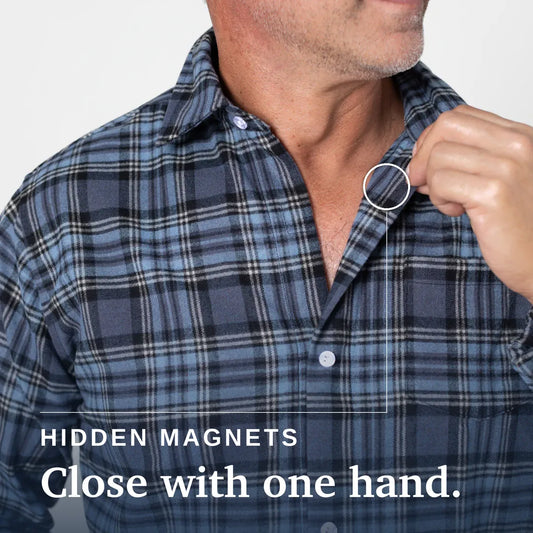
Magnetic Closures
Traditional buttons require precise finger movements and usually two-handed coordination.
Magnetic closures can allow the front of a shirt to fasten with less manipulation, which may help both the wearer and the person assisting.
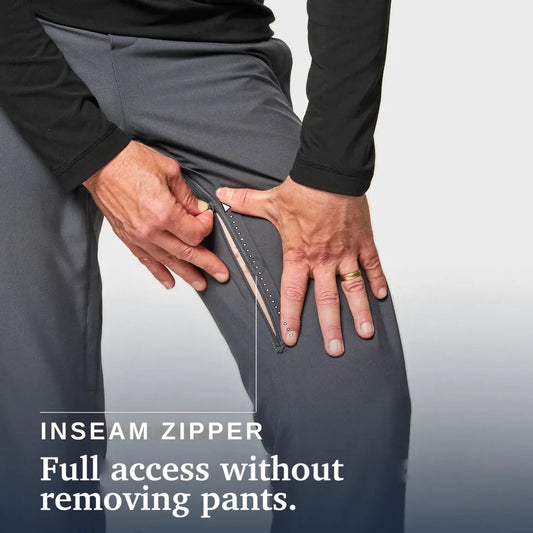
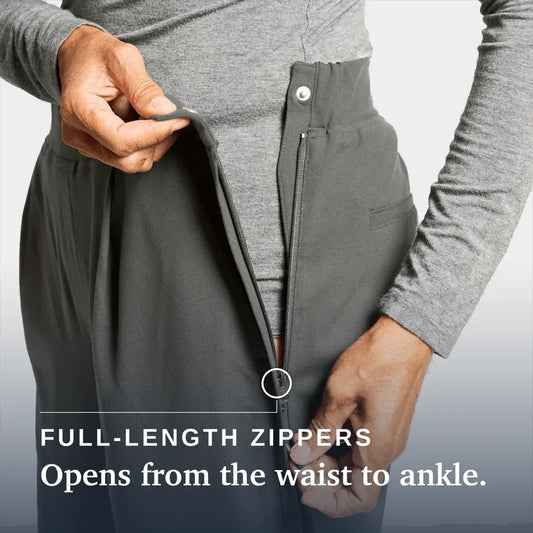
Side-Opening Pants

Pants that open along the sides can create a larger opening for the legs.
This may reduce the amount of leg lifting and pulling required during lower-body dressing.
Flexible Waistbands
Stretch or elastic waistbands eliminate some buttons, hooks and rigid waistband adjustments.
Wider Openings
Roomier sleeve, neck and pant openings can reduce how much the caregiver needs to push or pull the garment over the body.
Soft, Flexible Fabrics
Fabric with some stretch can move more easily around stiff joints and may require less force to position.
Easy-Access Clothing
For people who need help with toileting, incontinence care or medical-device access, clothing that opens strategically may reduce the need to fully undress.
Dressing Challenge → Clothing Feature
| Dressing Challenge | Clothing Feature That May Help |
|---|---|
| Small buttons are difficult | Magnetic closures or larger fasteners |
| Raising arms overhead is difficult | Front-opening tops |
| One arm has limited movement | Wide sleeves, front closures, one-handed designs |
| Stepping into pants is difficult | Side-opening pants |
| Standing to pull up pants is difficult | Seated-dressing designs and wider openings |
| Waistband fasteners are difficult | Flexible or elastic waistbands |
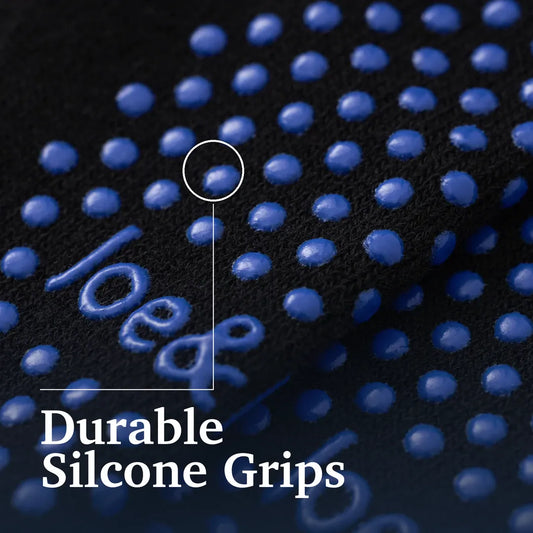
| Bending to put on socks is difficult | Flexible socks or a sock aid |
| Toileting requires caregiver help | Easy-access pants |
| Clothing causes irritation | Soft fabrics, flatter seams, tag-free construction |
Reduce Choices When Choices Become Overwhelming
If choosing clothing has become stressful, simplify the decision rather than eliminating choice entirely.
Instead of asking:
“What do you want to wear?”
try:
“Would you like the blue shirt or the green shirt?”
NIA recommends limiting choices for people with Alzheimer's disease and keeping only a small number of outfits available when too many options become confusing.
Keep the Routine Predictable
When someone struggles with memory, fatigue or anxiety, consistency can help.
That might mean:
- Dressing at roughly the same time
- Using the same chair
- Keeping frequently worn clothing in the same place
- Following the same dressing sequence
- Keeping dressing aids nearby
A familiar routine reduces the number of new decisions involved each day.
Protect Privacy and Dignity
Assisted dressing is personal.
Someone who spent decades dressing independently may feel embarrassed or frustrated about needing help.
Caregivers can help preserve control by:
- Explaining what you're going to do
- Asking before physically helping
- Keeping the person covered when possible
- Speaking directly to them rather than about them
- Allowing clothing and color preferences
- Avoiding unnecessary rushing
- Letting them complete whatever steps they still can
NIA notes that personal-care activities such as dressing may feel embarrassing or upsetting when a person begins needing assistance.
When Adaptive Clothing Can Help Caregivers
Adaptive clothing may be useful when the same dressing difficulty happens repeatedly.
Consider it when:
- Buttons require caregiver assistance every day
- Pulling shirts overhead is painful or difficult
- Pants require extensive lifting or repositioning
- Dressing takes much longer because of closures
- Toileting requires repeated undressing
- The person can complete more of the process with an easier garment
- The caregiver experiences physical strain during dressing
The goal is not simply faster dressing.
A useful adaptive feature should remove a specific barrier from the routine.
Adaptive Clothing vs. Dressing Aids
Not every dressing challenge requires new clothing.
Dressing aids may include:
- Button hooks
- Dressing sticks
- Sock aids
- Long-handled shoehorns
- Zipper-pull extensions
- Elastic shoelaces
An occupational therapist can help determine whether modifying the technique, using an assistive device or changing the clothing itself is the most appropriate solution.
When Dressing Difficulty May Need More Attention
A gradual need for more help can occur with aging or chronic conditions.
A sudden change, however, deserves attention.
Talk with an appropriate healthcare professional if someone suddenly:
- Cannot complete dressing steps they recently managed
- Develops new weakness, particularly on one side
- Has new or severe pain
- Becomes significantly less steady while dressing
- Experiences a major change in cognition or behavior
- Is losing independence across several daily activities
ADLs such as dressing are commonly used when evaluating how much help an older adult needs with personal care.
Final Thoughts
Helping someone get dressed is not simply a clothing task.
It involves mobility, comfort, communication, privacy and independence.
The best caregiver dressing routine usually does three things:
- Preserves whatever the person can still do independently.
- Removes unnecessary physical steps.
- Uses clothing or tools that solve the specific part of dressing that has become difficult.
Small changes, a different closure, a wider opening, a stable chair or simply preparing the outfit first, can make a daily routine easier for both the person getting dressed and the caregiver helping them.
About the Author:
Nurse Taylor Thoen Donaldson is Joe & Bella's Chief of Customer Happiness and a former geriatric nurse. Known to our customers as "Nurse Taylor," she brings a frontline caregiver's perspective to everything we do, helping ensure our products hold up not just in concept, but in the daily reality of getting someone dressed with limited time, limited mobility, and a lot on the line. Have a question or a topic you'd like her to cover? Just reply to this email.
A note from Joe & Bella: Our content is intended for general informational purposes only. While we share insights from our own Nurse Taylor and other health and wellness experts, please know that they are not your healthcare provider and nothing here should be taken as medical advice, diagnosis, or treatment. Every person's situation is different. Please consult your own physician, nurse, or healthcare professional before making any decisions about your health or the care of a loved one.
Frequently Asked Questions (FAQs)
-
CareZips® Men's Access PantsRegular price $88Regular priceUnit price per
$108Sale price $88Sale -
Everyday Gripper Socks 3-PackRegular price $48Regular priceUnit price per
$54Sale price $48Sale -
Everyday Magnetic Flannel for MenRegular price $78Regular priceUnit price per
$98Sale price $78Sale -
Everyday Side-Zip Pant for WomenRegular price $88Regular priceUnit price per
$108Sale price $88Sale