
Pulling up a pair of pants seems simple until bending, balance, strength, grip or use of one arm makes the movement difficult.
The challenge can happen for many reasons. Someone may be recovering from an injury or surgery, living with limited mobility, dressing from a seated position or experiencing changes in strength or dexterity.
The good news is that you do not necessarily have to keep struggling with the same pair of pants in the same way.
Sometimes changing your technique helps.
Sometimes a dressing aid helps.
And sometimes the easiest solution is simply choosing pants designed to require less pulling in the first place.
Quick Guide: What Can Make Pants Easier to Pull Up?
If pulling up pants is difficult, consider:
- Dressing while seated for as much of the process as possible
- Choosing pants with stretch
- Using a flexible or elastic waistband
- Avoiding very tight or rigid fabrics
- Looking for wider leg openings
- Using a dressing stick or reacher when appropriate
- Choosing pants with side openings or zippers
- Looking for larger areas of the waistband that are easier to grip
- Asking an occupational therapist about dressing techniques if mobility or balance is a concern
The best solution depends on which part of putting on your pants is actually difficult.
Why Is Pulling Up Pants Difficult?
Putting on pants requires more movement than we tend to realize.
You may need to:
- Reach toward your feet
- Guide each foot through a pant leg
- Pull fabric past your calves and knees
- Stand or shift your weight
- Pull the waistband over your hips
- Fasten the waist
- Adjust the pants around your body
Difficulty with any one of those steps can make the entire task frustrating.
Common barriers include:
- Difficulty bending
- Limited shoulder or arm movement
- Use of only one hand
- Reduced grip strength
- Arthritis
- Muscle weakness
- Balance difficulties
- Wheelchair use
- Recovery from surgery or injury
- Pants that are too tight or rigid
Rather than asking, “Why can't I get my pants on?” identify the particular step that creates the problem.
That makes it much easier to find a useful solution.
If Bending Down Is the Problem
For some people, the hardest part is getting the pants over the feet.
A traditional pair of narrow-leg pants may require considerable bending and reaching before you even begin pulling them toward the waist.
Try Wider Openings
Pants with wider leg openings create a larger target for each foot.
Stretch fabric can help as well because it allows the opening to expand rather than requiring the foot and leg to fit through a rigid shape.
Consider Side-Opening Pants
Adaptive pants can take this idea further.
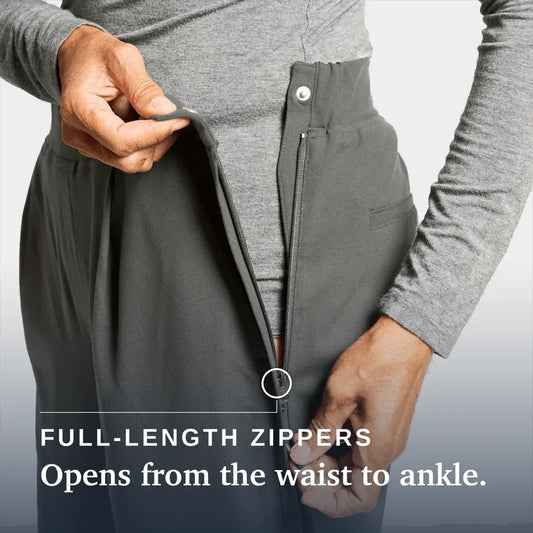
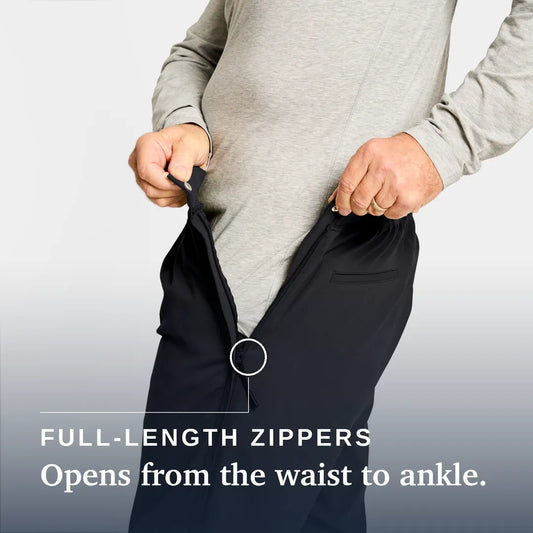
Full-length side zippers allow the sides of the pants to open from the waist toward the ankle.
Instead of trying to push your foot through a relatively narrow pant leg, you can open the garment much farther.
Joe & Bella's Everyday Side-Zip Pants use full-length side zippers on both sides, along with four-way stretch fabric and a flexible waistband.
The goal is simple:
Make the opening larger so the wearer has to do less maneuvering to get into the pants.
Use a Dressing Aid When Reaching Is Difficult
Dressing aids can help extend your reach.
Common examples include:
- Dressing sticks
- Long-handled reachers
- Grabbers
A dressing stick is designed specifically for dressing tasks. A reacher may also help some people manipulate clothing without bending as far.
For example, you may be able to use the tool to help position a pant leg or bring the waistband closer.
These tools work best when someone understands how to use them for their own movement abilities.
An occupational therapist can recommend the most appropriate dressing aid and demonstrate how to use it.
Difficulty Pulling Pants Over the Hips
Sometimes getting your feet into the pants is easy.
The problem happens later.
Pulling a waistband over the hips can require:
- Grip strength
- Shoulder movement
- Trunk movement
- Balance
- Repeated tugging
A very fitted waistband or rigid fabric makes the job considerably harder.
Look for Stretch
Stretch in both the fabric and waistband can reduce the amount of force needed to move the garment over the hips.
Look for:
- Stretch waistbands
- Four-way stretch fabrics
- Elastic panels
- Flexible waist construction
Give Yourself Something Easy to Grab
The smaller or more slippery the waistband, the harder it may be to hold.
Some adaptive pants include larger pull areas, loops or other features designed to give the hands a better place to grasp.
Even with conventional pants, look for a waistband that is easy for you to hold securely.
How to Pull Up Pants With One Hand
Pulling up pants with one hand can be especially difficult because most pants are designed with the assumption that both hands will pull on opposite sides of the waistband.
Start by making the clothing itself easier to manage.
Consider:
- Elastic or flexible waistbands
- Stretch fabrics
- Pants without complicated buttons
- Larger openings
- Side-opening pants
- Clothing that can be stabilized against the body or another surface
Occupational-therapy guidance for one-handed dressing generally recommends simplifying fasteners and choosing garments with elastic, roomy openings or other accessible features.
If one-handed dressing is new because of an injury, stroke or surgery, an occupational therapist can teach techniques appropriate for your affected side and movement restrictions.
For more complete guidance, see our guide to one-handed dressing techniques.
What If You Have an Arm or Shoulder Injury?
An arm injury can temporarily turn lower-body dressing into a one-handed task.
If your doctor or therapist has given you restrictions on shoulder or arm movement, follow those instructions first.
During recovery, easier pants may include:
- Elastic-waist pants
- Stretch pants
- Loose-fitting pants
- Pants without difficult buttons
- Side-opening pants
Do not use your injured arm simply to force a difficult pair of pants into place.
If you're repeatedly struggling with the same garment, switch to something easier while you recover.
Pulling Up Pants While Seated
Some people complete most or all of their dressing while sitting.
Seated dressing can reduce the amount of time spent balancing while stepping into clothing, but pulling the pants over the hips may require a different technique.
The appropriate method depends on:
- Whether you can stand at all
- Whether you can shift your weight from side to side
- Upper-body strength
- Wheelchair use
- Whether someone assists with dressing
Adaptive pants can be particularly helpful here because side openings can allow more of the garment to open around the body.
Joe & Bella's Everyday Side-Zip Pants are designed for seated as well as standing dressing.
If you're learning a new seated-dressing technique because of a disability or mobility change, an occupational therapist can help determine a method that fits your abilities and equipment.
Pulling Up Pants From a Wheelchair
Traditional pants are usually designed around standing dressing.
That can make them difficult for someone who dresses entirely or primarily from a wheelchair.
Useful clothing features can include:
- Full side openings
- Stretch fabric
- Flexible waistbands
- Wider leg openings
- Easy-to-grip closures
- A fit designed to remain comfortable while seated
The goal is to reduce the amount of lifting, pulling and repositioning required.
Depending on the individual's abilities, dressing may involve shifting weight from one side to another while seated rather than standing to pull the waistband into place.
Because wheelchair transfers and balance vary significantly from person to person, an occupational or physical therapist should guide any technique involving transfers or unsupported standing.
Are Pull-On Pants Easier?
Sometimes.
Traditional pull-on pants eliminate buttons, belts and conventional zipper flies, which can simplify dressing.
But “pull-on” does not necessarily mean “easy to put on.”
A pair of pull-on pants can still have:
- Narrow legs
- Tight elastic
- Heavy fabric
- A waistband that requires considerable pulling
- No way to open the sides
So instead of shopping only for the phrase “pull-on pants,” look at how the garment actually works.
Ask:
- How wide do the legs open?
- Does the fabric stretch?
- How much force does the waistband require?
- Are there side openings?
- Can I manage the garment with my available hand strength?
- Can I put these on in the position where I normally dress?
How Adaptive Pants Can Make Dressing Easier
Adaptive pants make dressing easier by being designed to change one or more of the steps involved in putting pants on.
They may use:
- Side zippers
- Wider openings
- Stretch waistbands
- Alternative fasteners
- Pull loops
- Easy-grip zipper pulls
- Seated-dressing designs
Not every person with a disability needs adaptive pants.
If ordinary pants work comfortably, keep wearing them.
Adaptive pants become useful when a feature of conventional pants repeatedly creates a barrier.
Full-Length Side-Zip Pants
Joe & Bella's Everyday Side-Zip Pants open along both sides from waist to ankle.
That creates a much larger opening than a conventional pair of pants.
They also use stretch fabric and a stretch waistband.
These pants can be useful when the challenge is:
- Getting the feet through the pant legs
- Bending toward the floor
- Pulling tight fabric over the legs
- Dressing while seated
- Needing assistance with dressing
CareZips Easy Access Pants
CareZips solve a somewhat different problem.
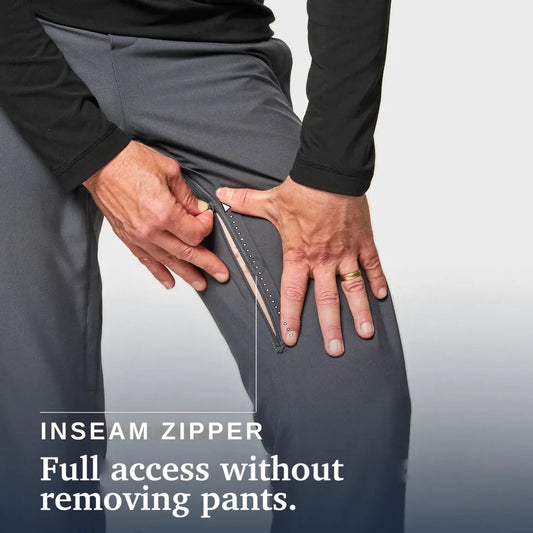
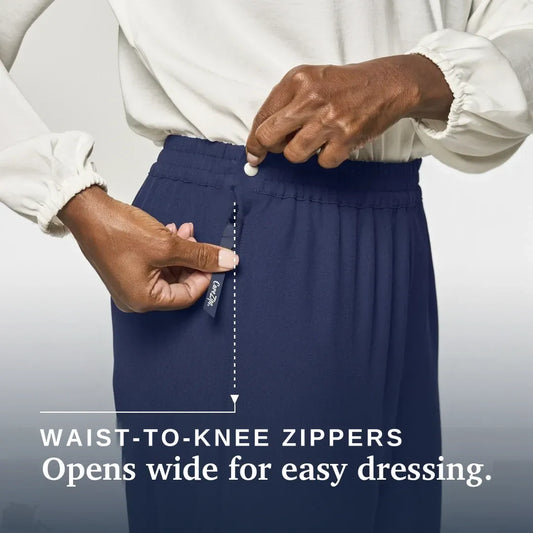
CareZips have side zippers for dressing plus an inseam zipper that provides access for toileting and personal care without fully removing the pants.
They may be particularly useful when someone needs both dressing assistance and easier bathroom or care access.
The best option depends on what is difficult about the current pair of pants.
Dressing Aids vs Adaptive Pants
You do not necessarily have to choose one or the other.
A Dressing Aid May Be Better When:
- Your existing pants otherwise work well
- Reaching toward the feet is the main problem
- You only need temporary help after an injury or surgery
- You are comfortable using an assistive device
Adaptive Pants May Be Better When:
- The pants themselves repeatedly create the problem
- You have trouble with narrow openings
- Fasteners are difficult
- You dress while seated
- You want fewer dressing tools to manage
- Someone regularly assists you with dressing
Some people use both.
What Pants Are Easiest for Someone With Limited Mobility?
There is no single best pair for everyone.
Look for pants that address the person's specific movement challenge.
Helpful features can include:
- Lightweight stretch fabric
- Flexible waistband
- Larger leg openings
- Side zippers
- Minimal complicated fasteners
- Easy-to-grip pulls
- Enough room for seated movement
The pants should also fit properly.
Oversized clothing is not automatically easier to manage, and excessively loose fabric can create its own problems.
What If You Can Get the Pants On but Can't Fasten Them?
In that case, the waistband closure may be the actual problem.
Look for:
- Elastic waistbands
- Snaps
- Larger zipper pulls
- Alternative closures
- Pull-on designs
If fine-motor control is the primary issue rather than mobility, changing the closure may solve the problem without changing the rest of the pant design.
When to Ask an Occupational Therapist for Help
An occupational therapist can be particularly useful when dressing difficulty is new or is interfering with everyday independence.
They can assess:
- Where in the dressing sequence you are struggling
- Your available range of motion
- Hand strength and dexterity
- Balance
- Seated versus standing dressing
- Dressing aids
- Clothing adaptations
Rather than simply telling you to “try harder,” an occupational therapist can help change the task, equipment or environment around your abilities.
Start With the Part That's Difficult
You do not need to replace your entire wardrobe because one part of getting dressed has become harder.
Start by identifying the exact problem.
If you cannot reach your feet, a dressing aid or wider pant opening may help.
If pulling fabric over your hips requires too much effort, look for stretch and a more flexible waistband.
If buttons and zippers are the problem, simplify the closure.
If conventional pants require more bending, pulling or standing than you can comfortably manage, adaptive pants can change how the garment opens rather than asking you to keep changing how your body moves.
The goal is not simply to get the pants on.
It is to make getting dressed work better for you.
About the Author:
Nurse Taylor Thoen Donaldson is Joe & Bella's Chief of Customer Happiness and a former geriatric nurse. Taylor worked extensively with older adults as they recovered and prepared to leave the hospital. Known to our customers as "Nurse Taylor," she brings a frontline caregiver's perspective to everything we do, ensuring our products hold up not just in concept, but in the daily reality of dressing someone with limited time, limited mobility, and a lot on the line.
A note from Joe & Bella: Our content is intended for general informational purposes only. While we share insights from our own Nurse Taylor and other health and wellness experts, please know that they are not your healthcare provider and nothing here should be taken as medical advice, diagnosis, or treatment. Every person's situation is different. Please consult your own physician, nurse, or healthcare professional before making any decisions about your health or the care of a loved one.
Frequently Asked Questions (FAQs)
-
CareZips® Men's Access PantsRegular price $78Regular priceUnit price per
$108Sale price $78Sale -
CareZips® Women's Access PantsRegular price $74Regular priceUnit price per
$108Sale price $74Sale -
Everyday Side-Zip Pant for WomenRegular price $78Regular priceUnit price per
$108Sale price $78Sale -
Everyday Side-Zip Pants for MenRegular price $78Regular priceUnit price per
$108Sale price $78Sale




2 comments
my husband had a stroke and his left arm no longer functions. He can’t pull his pants over his butt on the left side often leaving his butt exposed, we would appreciate any suggestions. TY
I can’t put on my jeans eap button n belt