Adaptive clothing is apparel intentionally designed to make getting dressed and undressed easier for people who may struggle with traditional clothing because of limited mobility, reduced hand dexterity, disability, cognitive changes, medical recovery or the need for caregiver assistance.
Instead of changing how clothing looks, adaptive design changes how it works. Features such as magnetic closures, side zippers, elastic waistbands, wider openings and seated-fit construction can reduce the bending, reaching, gripping and fine-motor movements required to get dressed.
The best adaptive clothing combines those functional changes with the comfort, fit and personal style you would expect from any other clothing.
In this guide, we'll explain who adaptive clothing is for, how it differs from traditional clothing, common examples and features, and how to choose the right garments for a specific dressing need.
What Is Adaptive Clothing?

Adaptive clothing is clothing that has been modified or designed differently to solve a specific dressing, mobility, comfort or care challenge.
That might mean replacing small buttons with hidden magnetic closures, adding zippers to the sides of pants so the legs can open more fully, changing the rise of pants for someone who remains seated, or using softer fabrics and flat seams for sensitive skin.
Common adaptive clothing features include:
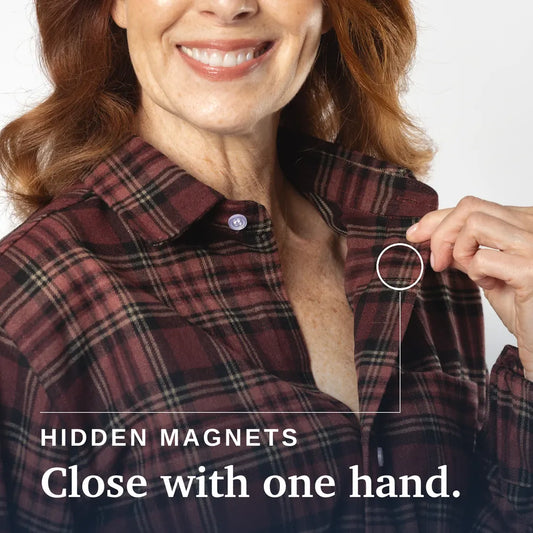
- Magnetic closures that replace traditional buttons
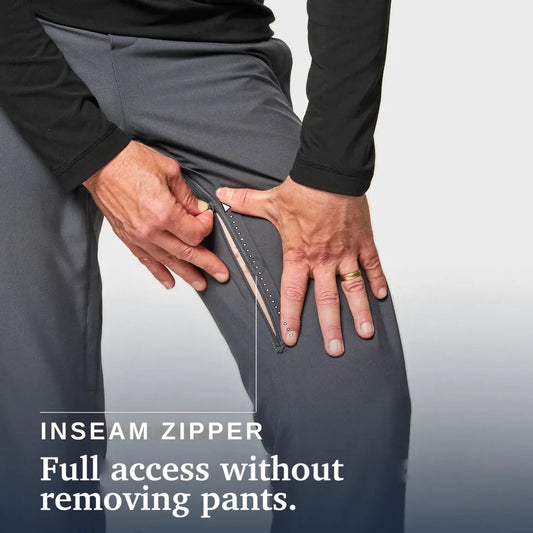
- Side, inseam or strategically placed zippers
- Hook-and-loop closures
- Elastic or adjustable waistbands
- Wider neck, sleeve and leg openings
- Open-back or fully opening garments
- Pull loops that make clothing easier to grip
- Seated-fit pants designed for wheelchair users
- Flat seams, tag-free construction and soft fabrics
- Easy access to braces, prosthetics, catheters or other medical devices
Not every adaptive garment uses the same features. The right design depends on what makes dressing difficult for the person wearing it.
How Is Adaptive Clothing Different From Regular Clothing?
Traditional clothing is generally designed around the assumption that the wearer can stand, bend, reach, grip small fasteners and move both sides of the body easily.
Adaptive clothing changes the construction of the garment when those movements become difficult.
| Traditional Clothing | Adaptive Clothing |
| Small buttons may require fine finger control | Magnetic or larger closures can reduce the dexterity required |
| Pants usually require stepping through narrow leg openings | Side-opening pants can create a wider opening or allow dressing while seated |
| Shirts may need to be pulled over the head | Front-, side- or back-opening tops can reduce overhead movement |
| Standard pants are patterned primarily for standing | Seated-fit pants can improve coverage and comfort while sitting |
| Zippers and waistbands may require two-handed coordination | Alternative closures and pull loops can simplify one-handed dressing |
| Clothing may need to be removed to reach a medical device | Strategic openings can provide easier access |
| Seams, tags or stiff fabrics may cause irritation | Softer fabrics, flat seams and tag-free construction can improve comfort |
The goal is not to make clothing look medical. It is to remove unnecessary dressing barriers while preserving fit, comfort and personal style.
Who Benefits From Adaptive Clothing?

Adaptive clothing can help anyone whose body, mobility or dressing routine makes traditional clothing difficult to use.
Older Adults
Changes in hand strength, arthritis, balance, shoulder mobility and flexibility can make once-simple dressing tasks more difficult.
Adaptive clothing can reduce the amount of gripping, reaching, bending or twisting needed to get dressed while allowing older adults to continue wearing familiar styles.
People With Disabilities
People with physical disabilities may encounter very different dressing challenges depending on mobility, strength, dexterity and whether they dress standing, seated or lying down.
Adaptive features can be especially useful for wheelchair users, people with cerebral palsy, people with spinal cord injuries and anyone with limited use of one or both sides of the body.
People With Arthritis or Limited Hand Dexterity
Traditional buttons, zipper pulls and other small fasteners can become difficult when finger movement, grip strength or hand coordination is limited. That's why adaptive clothing for arthritis patients is such a game changer.
Magnetic closures, larger zipper pulls and elastic waistbands can reduce the fine-motor effort involved.
People Recovering From Surgery or Injury
Shoulder, hip, knee, abdominal and other surgeries can temporarily limit range of motion.
Adaptive clothing for surgery recovery that opens more fully can help someone dress without unnecessary overhead reaching, deep bending or pulling a garment across a healing area.
Stroke Survivors and People Dressing With One Hand
Weakness or limited coordination on one side of the body can make traditional two-handed dressing more difficult.
Adaptive clothing for stroke patients with easy closures, wide openings and simplified fastening systems can support one-handed dressing techniques.
Wheelchair Users
Clothing designed for standing may fit differently once someone is seated for long periods.
Wheelchair-friendly apparel can include higher back rises, reduced bulk, thoughtfully positioned seams and pockets, stretch fabrics and openings that make seated dressing easier.
People With Prosthetics, Braces or Medical Devices
Strategic openings can make it easier to reach or accommodate braces, prosthetic limbs, casts, catheter bags or other medical equipment without fully removing a garment. Look for either general adaptive clothing for specific adaptive pants or tops for prosthetics.
People With Cognitive Changes
Dementia and other cognitive conditions can make complicated dressing routines more frustrating.
Adaptive clothing for dementia and Alzheimer's should highlight familiar-looking clothing with simpler closures and fewer dressing steps may make the process easier for both the wearer and caregiver.
Caregivers
Adaptive clothing can also make assisted dressing easier.
Garments that open more fully or require fewer complicated fastening steps may reduce unnecessary repositioning and physical effort during dressing, toileting and personal care.
What Are Examples of Adaptive Clothing?
Adaptive clothing is a broad category. Some designs look almost identical to traditional clothing while others use more visible adaptations.
Magnetic Button Shirts

Magnetic button shirts look like traditional button-downs, but hidden magnets take the place of standard button-and-buttonhole closures.
They can be particularly useful for people who like the appearance of a classic button-down but struggle with small buttons because of arthritis, tremors or limited dexterity.
Side-Zip Pants

Side-zip pants use zippers along one or both outer seams to create a larger opening.
Depending on the design, this can reduce how far someone needs to bend or lift the legs and can make dressing easier while seated.
Easy-Access Pants
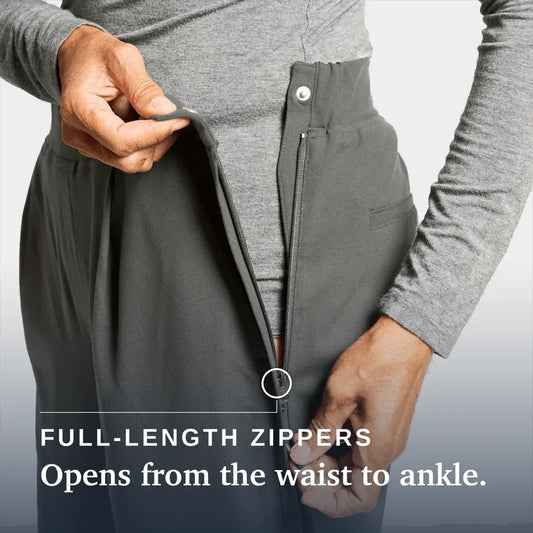
Some adaptive pants include multiple openings to simplify dressing, toileting, incontinence care or access to medical devices.
Joe & Bella's CareZips®, for example, use three strategically placed zippers so the pants can open more extensively without requiring the wearer to fully undress.
Adaptive Tops
Adaptive shirts, sweaters and jackets may use:
- Magnetic buttons
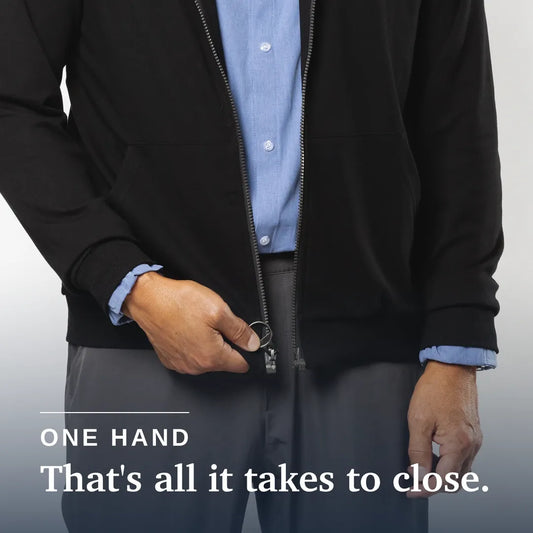
- Magnetic zippers
- Side openings
- Wider necklines
- Open backs
- Shoulder openings
- Stretch fabrics
The best option depends on whether the primary challenge is hand dexterity, shoulder movement, one-handed dressing or caregiver assistance.
Wheelchair-Friendly Clothing
Wheelchair-friendly clothing may be cut differently from standard clothing to improve comfort and coverage while seated.
For pants, this can include a higher back rise, reduced bulk beneath the body, stretch fabrics and strategic seams or pockets.
Adaptive Socks
Easy-on socks may include additional stretch or design changes that make them easier to pull onto the foot.
Gripper socks add traction for indoor surfaces, while compression socks serve a different purpose and may require specific sizing and compression levels.
Clothing for Sensitive or Fragile Skin
Adaptive clothes for sensitive skin can also focus on comfort rather than closures.
Soft fabrics, flat seams, tag-free construction and reduced friction can be useful for older adults and anyone whose skin is easily irritated.
Why Was Adaptive Clothing Created?

Traditional fashion has historically assumed a fairly narrow range of movement: that the wearer can stand, reach overhead, bend toward the feet, grip a zipper and manipulate small buttons.
Those assumptions do not work for everyone.
Adaptive clothing developed to remove some of those barriers by changing the garment instead of asking the wearer to work around it.
That principle is closely related to universal design: products should be easier for as many people as possible to use without sacrificing appearance or function.
A magnetic shirt may have been designed for someone with arthritis, for example, but the same feature can also be useful for someone dressing with one hand, recovering from surgery or simply looking for an easier fastening system.
Adaptive Clothing for Seniors: Why Style Matters

Our own perspective on adaptive apparel was shaped by family caregiving.
While helping care for my grandmother, I saw how painful something as ordinary as putting on a cardigan could become. We tried several adaptive garments that were easier to put on, but she did not want to wear them because they did not feel like her style.
That experience taught us something important: making a garment easier to put on is only part of the solution.
People still want clothing that feels familiar, flattering and appropriate for their lives.
Adaptive clothing for seniors should solve a functional problem without asking someone to give up personal style in exchange.
How Adaptive Clothing Can Make Dressing Easier
Different adaptive features solve different problems.
If Buttons Are Difficult
Look for:
- Magnetic buttons
- Larger fasteners
- Easy-grip zipper pulls
- Simplified closures
If Reaching Overhead Is Difficult
Look for:
- Full-front openings
- Side-opening tops
- Cardigans
- Jackets or hoodies with easy zippers
- Wider neck openings
If Bending or Lifting the Legs Is Difficult
Look for:
- Side-opening pants
- Wider leg openings
- Elastic waistbands
- Pull loops
- Clothing that can be put on while seated
If Dressing With One Hand
Look for:
- Magnetic closures
- Easy zippers
- Stretch fabrics
- Wider openings
- Pants that do not require simultaneous fastening and balancing
If Someone Dresses While Seated
Look for:
- Higher-rise backs
- Stretch fabrics
- Reduced seam or pocket bulk
- Side openings
- Clothing designed specifically for seated fit
If a Caregiver Assists With Dressing
Look for:
- Garments that open more fully
- Fewer complicated fasteners
- Easy access for toileting or medical care
- Fabrics that move easily during dressing
- Designs that reduce unnecessary repositioning
How to Choose Adaptive Clothing
Before choosing a garment, start with the dressing problem rather than the diagnosis.
Two people with arthritis, for example, may need completely different clothing if one struggles mainly with hand dexterity while the other has limited shoulder mobility.
Ask:
-
Which part of dressing is difficult?
Buttons? Pulling pants up? Reaching overhead? Bending? Balancing? -
Does the person dress independently or with assistance?
-
Do they usually dress standing, seated or lying down?
-
Which movements cause pain or difficulty?
-
Are medical devices, braces or prosthetics involved?
-
Which closures are easiest to operate?
Magnetic, zipper, hook-and-loop or elastic? -
What does the person actually want to wear?
Function matters, but so do fit, fabric, color and personal style.
What Should Adaptive Clothing Not Be?
Adaptive clothing should not automatically look clinical, institutional or obviously medical.
Function is essential, but people should not have to choose between clothing that works for their body and clothing they actually want to wear.
Good adaptive design should feel intentional rather than improvised. Closures should be integrated into the garment, fabrics should feel appropriate for everyday use, and the finished piece should look like clothing first.
Where Can You Buy Adaptive Clothing?
Adaptive clothing is available through:
- Dedicated adaptive-apparel brands
- Major fashion and footwear companies with adaptive collections
- Medical and senior-care retailers
- Online marketplaces
- Specialty brands focused on specific dressing needs, like Joe & Bella
When comparing options, look beyond the word “adaptive.” Pay attention to the specific feature and whether it actually addresses the dressing problem you are trying to solve.
Joe & Bella's Approach to Adaptive Clothing
At Joe & Bella, we design adaptive clothing around common dressing challenges while aiming to keep the adaptation discreet.
Our clothing includes features such as:
- Hidden magnetic buttons
- Magnetic zippers
- Side-opening pants
- Easy-access CareZips® pants
- Stretch and comfort-focused fabrics
- Gripper and compression socks
Our goal is straightforward: make clothing easier to use without making it look like a medical product.
Key Takeaways
- Adaptive clothing is designed to remove barriers that make traditional clothing difficult to put on, take off or wear comfortably.
- Common adaptive features include magnetic closures, side zippers, elastic waistbands, strategic openings and seated-fit construction.
- Older adults, people with disabilities, people recovering from surgery, wheelchair users, people with limited dexterity and caregivers can all benefit.
- The best garment depends on the specific dressing challenge rather than simply a diagnosis.
- Adaptive clothing does not need to look medical. Good design combines easier dressing with comfort, fit and personal style.
Physical changes should not prevent someone from wearing clothing that feels like them. Adaptive design simply changes the garment to work better for the person wearing it.
Common adaptive features include:
- Magnetic closures instead of buttons
- Side or back zippers for easier access
- Velcro fasteners for one-handed dressing
- Elastic waistbands that don't require belts
- Open-back designs for seated dressing
- Wider leg openings for casts or braces
The best adaptive clothing looks just like regular clothing. You wouldn't know it's adaptive unless you looked closely at the construction.
Ready to experience the difference adaptive clothing can make? Explore Joe & Bella's collection of adaptive pants, tops, and more, designed for comfort, dignity, and everyday style.
About the Author
Jimmy Zollo is the co-founder and CEO of Joe & Bella. His work in adaptive apparel grew out of years spent caring for and advocating for his grandparents and researching aging-related issues. His experience has shaped Joe & Bella's focus on making dressing easier without treating adaptive clothing as a medical uniform.
Frequently Asked Questions (FAQs)
-
CareZips® Men's Access PantsRegular price $88Regular priceUnit price per
$108Sale price $88Sale -
Everyday Magnetic Flannel for WomenRegular price $78Regular priceUnit price per
$98Sale price $78Sale -
Everyday Side-Zip Pant for WomenRegular price $88Regular priceUnit price per
$108Sale price $88Sale -
HoodEase®: The Magnetic Zip-Up HoodieRegular price $98Regular priceUnit price per
$108Sale price $98Sale